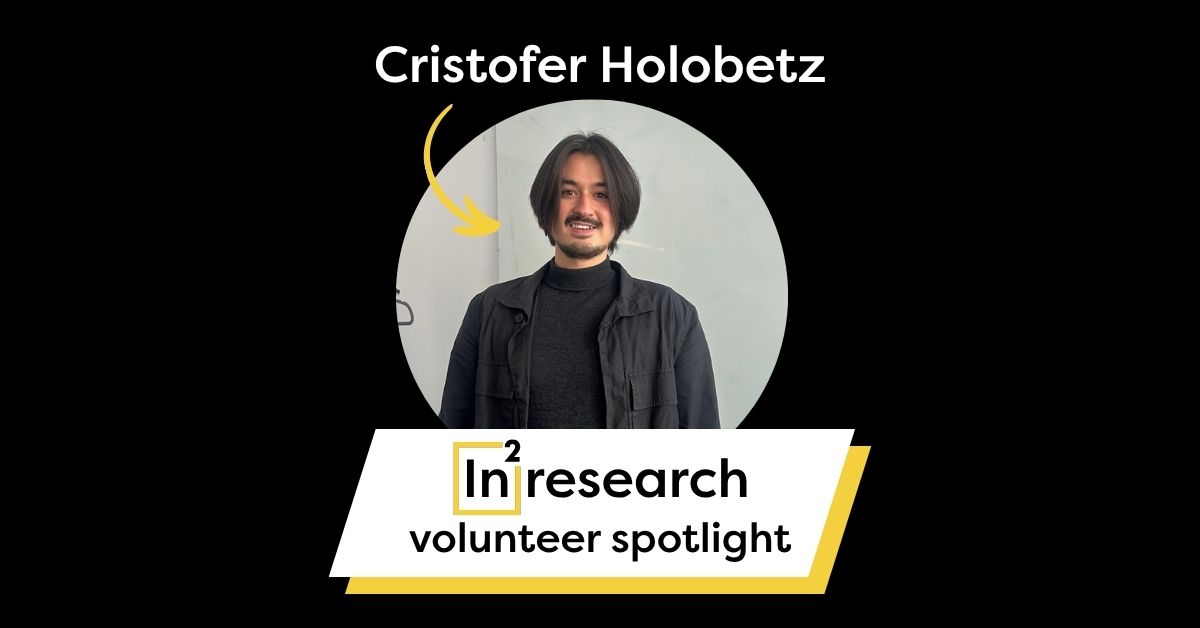
In2research placement host Cristofer Holobetz, who hosted a Neuroscience placement at the Sainsbury Wellcome Centre at UCL, discusses his experience as an In2scienceUK volunteer.
How did you find out about In2scienceUK and what made you want to volunteer for our In2research programme?
Last year, a colleague of mine was already hosting, so she got me involved. I wanted to get involved with In2scienceUK because personally, I find it very unfortunate that the demographics of people who pursue science are not representative of people from working-class backgrounds, and that, as a result, there is often a very white-collar, upper-middle-class culture in science.
I think it is very important that young people are given paid opportunities to access science, as I once was, so it was important to me that I volunteered and gave back. It has been fantastic to take part this year and host a placement!
What has your participant Devanshi been working on as part of her placement?
Here we work on studying the hippocampus, which supports fast memory of particular episodes – something that happens once but is remembered – as well as learning that occurs across many experiences. It interacts with the cortex to identify regularities and learn general rules, which eventually form semantic memories.
In our lab, we train mice to perform tasks and record their brain activity as they learn. This allows us to see when and how they are engaging episodic versus semantic memory, and to test different theories about the hippocampus’ role. There are three or four prominent computational models of how the hippocampus works. They all propose broadly similar ideas, but with important differences. With the kind of data we are collecting, we will be able to directly compare these models and potentially rule out some in favour of others.
What Devanshi was doing was applying these existing models to our experimental task, generating predictions, and testing them against the data. Having Dev bring an outside perspective to this work is especially valuable. Her work is making an important contribution to the project, and she also played an active role in our weekly lab meetings.
Has the In2research participant you worked with contributed to your research goals or helped to advance your work in any way?
What Dev has been doing is something I’ve wanted to pursue for quite a while, but I hadn’t been able to prioritise it alongside other parts of the project. It’s exactly the kind of work I would have done at some point, but having her here has meant we’ve been able to move forward with it much sooner. Her involvement has helped to accelerate this aspect of the research.
What has the experience meant to you?
For me, it aligns with my preferences for the kind of volunteering I want to do. I’ve supervised people in the past who already had connections and access to opportunities, but I find it much more satisfying to work with someone who might not otherwise have had the chance. It feels much more meaningful.
The fact that the placement is properly financed is also incredibly important. I was able to get into research myself because I was lucky enough to find a lab that paid me, but most don’t. If you don’t have financial support from your family, that can be a real barrier. In2research helps remove that barrier, and I think that makes a big difference.
Have you enjoyed being an In2scienceUK volunteer? Would you recommend it to others?
I think the experience has been really good overall! One aspect I particularly valued was the race and cultural literacy training; I found it very useful, and I was glad it was included as part of the programme.
I would definitely say do it! Volunteering for In2research has been really fun and rewarding, and in my experience, it hasn’t been a huge amount of extra work. At the start, I was a bit unsure about how much independence to give Dev, but we quickly found a good balance. She has been able to work very independently, which has made the supervision process smooth and enjoyable.
Cristofer Holobetz took part in our In2research 2024/25 programme – if you’re feeling inspired to get you or your organisation involved, applications for the 2027 programme are open now until 23rd August for both mentors and placement hosts. Find out more and apply by visiting our In2research volunteer page.