Frequently Asked Questions for Placement Hosts
Welcome to In2STEM Hosting FAQs. Here, you can discover answers to frequently asked questions about the In2STEM programme and your involvement as a Host. Our goal is to provide clear information and support your In2STEM journey.



Programme Information
What does the programme involve?
The In2STEM programme involves multiple aspects for the students. Once enrolled on the programme, students will attend an induction where they will meet their cohort and learn about In2STEM. They will then take part in work experience placements hosted by our volunteers. Alongside their placements, students will also attend online workshops to teach them employability skills and help them learn more about the world of STEM.
Students are also able to enter competitions to show off their achievements and win great prizes. We round up the programme with a celebration event to congratulate the young people and thank our wonderful volunteers for their support and hard work.
Hosting a placement will likely be the only aspect of the programme that you will be directly involved in.
Attend a Volunteer Information Session to find out more about the programme.
When does the programme run?
The programme will run between Monday 20 July – Friday 21 August 2026. All placements will take place within this timeframe.
What is the timeline for taking part?
- 8 December 2025 – Applications open
- December 2025 – April 2026 – Volunteer Information Sessions (All 2026 session now been delivered)
- 5 April 2026- Applications deadline
- April/May 2026 – Hosts find out if they have been matched with students
- June 2026 – Host Inductions
- Monday 20 July to Friday 21 August 2026 – Work experience placements take place
- Autumn 2026 – Celebration Events are held
What will the training be and when will it be held?
We will run induction sessions online where we will give tips and guidance on how to plan and deliver your work placement. The training will be held in June on multiple dates, and will be recorded for anyone who is unable to attend.
We also provide a comprehensive Volunteer Guide that you can refer to throughout the programme. In this guide, there are examples of past activities, tips on running a successful placement, safeguarding procedures, useful resources and so much more!
Who is eligible to participate as a Host?
We welcome applications from anyone who is currently working within the field of science, technology, engineering and maths in the UK. This includes PhD students. Unfortunately, applications from current undergraduate or masters students will not be considered due to the requirement to host students at your workplace. We are particularly keen to host placements in more industry based STEM settings so please get in touch if you are interested in applying.
The In2STEM programme currently runs nationwide across England, Scotland and Wales. This includes regions such as London, Cambridge, Exeter, Cardiff, Birmingham, Liverpool, Manchester, Leeds, Glasgow, Edinburgh and many more!
We are always looking to expand our programme to new regions and give as many inspirational young people the opportunity to participate as possible. This year, we are particularly interested in hosting placements in the North East (Newcastle and Durham), Plymouth, South Wales and Norwich so please do get in touch if you are interested in running a placement in one of these locations.
Your Application
How does the selection process for Hosts work?
Our applications are not merit-based and matches are made by aligning student interests, location and availability. This means that we are not able to guarantee all eligible volunteer applicants will be successfully matched to student(s) to host.
Whilst we do accept applications from professionals across the breadth of the STEM sector, we receive the highest demand from our students for placements with a hands-on or research focus, and these volunteers will therefore have higher chances of being selected.
What information will I need to provide in the application?
Our applications are designed to capture the necessary information to allow us to match you to a suitable student(s) to host for the placement.
Please find an example application form here.
To give you an idea for now, the information we ask for is:
- Personal details
- Your place of work
- Your area of expertise
- Examples of activities students will do on a placement with you
- Availability and capacity
- Risks and sensitivities
- Consent
When is the deadline to submit a Host application?
The final deadline for all applications is 5 April 2026.
What is the difference between an Individual and Co-Hosting application?
Our applications are split into two categories: Individual and Co-Hosting. Below are definitions of each category to help you select the right one for your placement.
- Individual Application – select this option if you are applying as a lone volunteer to host students. We would recommend hosting a minimum of three students.
Example: Joe Bloggs is volunteering alone and hosts 3 students on week 1 of the programme. - Co-Hosting Application – select this option if you are applying on behalf of yourself and other colleagues to host together. This includes small groups, larger departmental teams or organisations. Multiple people help contribute to the planning and delivery of the placement. We recommend a minimum of six students.
Example: Joe Bloggs is volunteering with his colleagues Jane Doe and John Doe as co-hosts. They host 6 students on week 2 of the programme with Joe Bloggs being the Lead Host.
For all applications, the person completing the form will be considered the ‘Lead Host’. They will be our main point of contact for the whole placement.
Can I host multiple placements?
If you want to host multiple placements at the same location, please contact us as we require an application for each placement. We will support you with this.
Example: You want to host a placement on Week 1 for 6 students and another placement on Week 2 for 5 students – we would need 2 applications in this scenario.
Who can I nominate as my second point of contact?
This should be a colleague, ideally someone who works in the same department or team as you and is aware or supporting with your placement. We will only contact this member of staff regarding the placement if the Lead Host is unavailable due to reasons such as illness or leave.
How can I increase my chances of being matched with students?
Students are matched with hosts based on a number of different criteria, including subject interests, placement location and student and host availability. Due to the nature of the programme, unfortunately we cannot guarantee all host applications will be successfully matched with students.
To maximise your chances of being matched to a participant, try to answer all questions accurately and provide as much detail as possible. It is especially important to select appropriate keywords, to help describe your subject area. It is also crucial to be as accurate as possible when selecting your availability and to let us know if your availability changes. Make sure your bio introduces you and your work in a way that is accessible to students who may have limited knowledge of your field. Including examples of activities students will do whilst on placement with you will be extremely helpful during the matching process.
Try to apply early and if you’re unsure about anything, contact us via [email protected]
Hosting a Placement
What is the expected time commitment for hosting a placement?
An approximation of a host’s time commitment are:
- Application form – This should take 20-30 minutes to complete.
- Planning placement activities – We estimate it will take approximately one full day, spread over time, for arrangements to be made. If you’re unsure of the types of activities to plan, we offer support and talk through example activities during the host inductions. You can also find additional information and guidance in the volunteer guide.
- Admin tasks – This will include submitting a risk assessment, communicating with students, signing our Code of Conduct and Safeguarding Policy, undergoing a DBS check if necessary and any other admin that your organisation requires. This will take approximately one full day, spread over time. Our team will support you with these tasks and we have created resources, such as email and risk assessment templates, to help speed up the process.
- Online induction – We expect all hosts to attend one host induction session ahead of the placements. The host induction session will be one-hour long and a recording will be made available to those who cannot attend the live session.
- Running the placement – This will take place over one or two weeks, depending on your availability and preference.
What will I be expected to do for the work placement and how do I arrange this?
You can read our example timetables to get an idea of the types of activities that can be included. If successfully matched to a group of students, we will also provide a guide and an induction session that will help you to plan your placement. We suggest planning a mixture of hands-on and hands-off activities to fit around your work schedule. Hands-on activities can include undertaking experiments, mock interviews, scenario tasks and data analysis. Hands-off activities can involve attending team meetings, interviews with other colleagues and setting research or presentations for the students. You can also give them time to work on In2STEM public engagement competition entries or CREST projects. The In2STEM team will provide support and resources to help plan placement activities.
As a placement host, you will be responsible for completing necessary checks and paperwork ahead of the placement. For example, your organisation may require students to have visitor lanyards or additional security inductions. This will depend on your place of work and protocols in place. After your induction, you will receive the contact details of your student(s). This allows you to introduce yourself, arrange any necessary checks and provide important information about the placement such as meeting points and any health and safety requirements.
What is the length of the work placements?
We are looking for volunteers who can host a one or two week work experience placement.
Do I need to provide resources for the students on my placement, for example laptops?
Unfortunately due to the scale of the programme, we are unable to support with resources for placements and this is something you would need to provide. In universities there is often extra budget for outreach activities. It is worth keeping in mind that not all students have their own device that they could bring with them to a placement.
I can’t host a placement in 2026. Is there any other way I can volunteer?
In addition to the work placements, we also run volunteer-led online workshops during the summer. If you are interested in supporting the delivery of a workshop, please complete this form. Please note that we run a limited number of workshops each year so can only accommodate volunteers when there are spaces available.
If you’re interested in hosting a placement the following year, please complete this Expression of Interest Form and we’ll get in touch with you when applications open for the 2027 programme.
Other Enquiries
How are students selected?
Student applicants are shortlisted before we match them to a host. Our selection criteria is based on data published by the Department for Education which identifies those most under-represented at university and in STEM and research careers. We do not take grades or academic performance into account.
Core Criteria:
- Students must be currently attending a state-funded school.
- Students must be 16 years old or over and a current year 12 student or equivalent.
- Students must be studying at least one STEM-related A-Level, BTEC or equivalent.
- Students must be within commutable distance of their placement location (usually less than one hour but can be longer if the student agrees).
Additional Criteria:
To be considered for our shortlist, students must meet a minimum of one of the following criteria.
- Be from a low socioeconomic background
- Be a recipient of or eligible for Free School Meals (FSM) in year 11, or at Sixth form (or equivalent).
- Be a current recipient of Education Maintenance Allowance (EMA), Pupil Premium or the 16-19 Bursary.
- Have been or are currently in care, or have caring responsibilities.
- Have parents or guardians who do not have a higher education degree.
- Have an Education Health and Care Plan (EHCP).
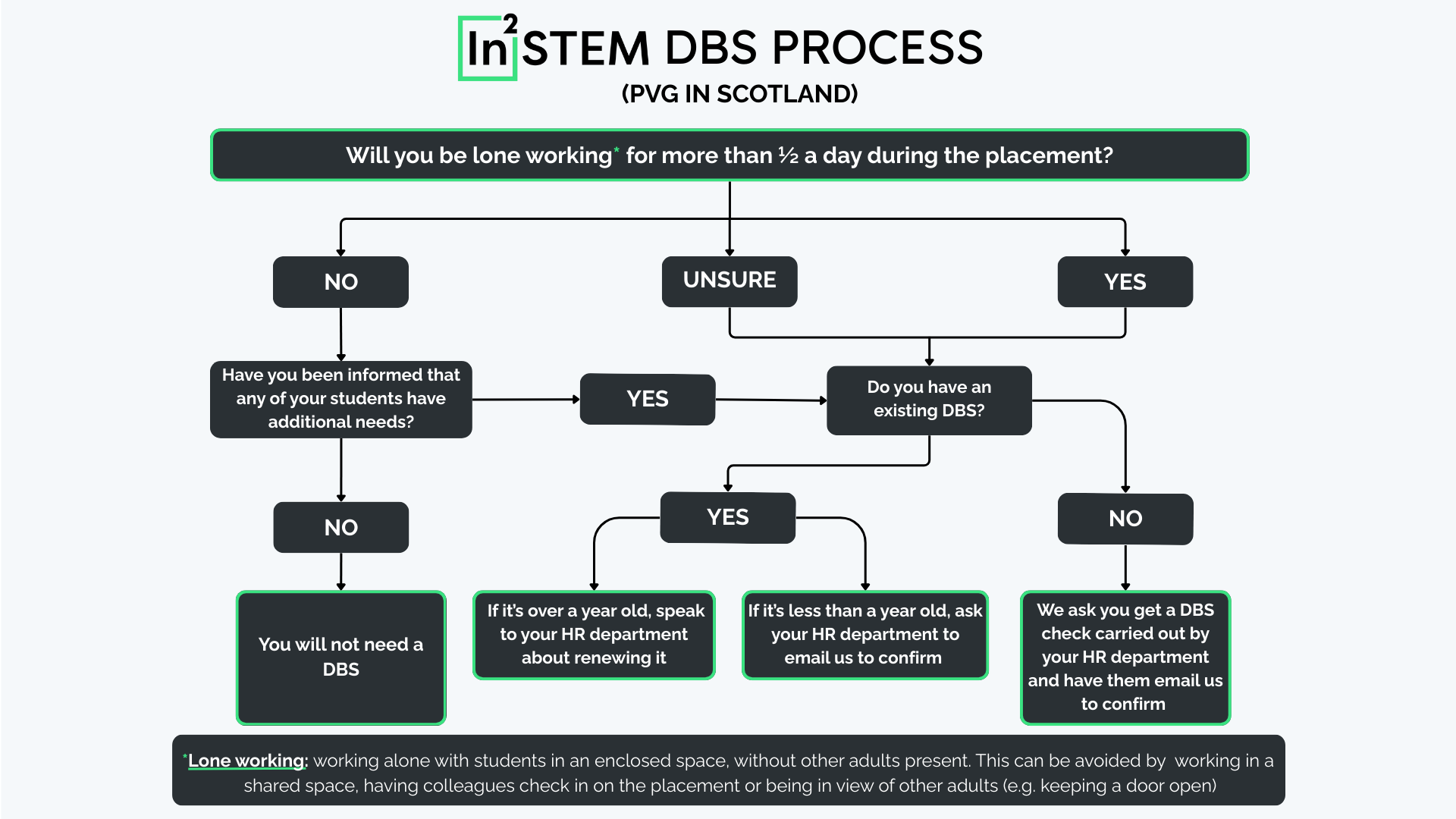
Do I need a DBS check?
All volunteers will receive guidance on In2scienceUK’s safeguarding processes and are required to read our Safeguarding Policy before placement begins.
We also ask you to familiarise yourself with the safeguarding policies and process of your organisation and inform HR or someone responsible that you will be hosting a placement with a student, likely aged 16-17.
While DBS checks will not be required in all placements, depending on the nature of the placement, we may request DBS checks and/or self-disclosure information as part of our necessary safeguarding measures to protect the young people on our programmes. We highly recommend that all hosts have an up to date DBS.
You can check our DBS flowchart to understand if a DBS will be needed.
Will I need a risk assessment and/or insurance?
For safety, all hosts will need to confirm that they have an HSE-compliant risk assessment in place. The risk assessment must be in place in advance of the placement starting and should be continually updated where necessary. Your organisation may have a risk assessment template that you can use.
Participants will need to be covered by your organisation’s workplace insurance. Most organisations, especially large organisations such as universities, have simple, established procedures for this.
How can I get in contact if I have further questions?
We are running a series of Volunteer Information Sessions during December 2025-April 2026 that introduce the programme to anyone who might be interested in volunteering.
Each session will include a short presentation and time for Q&A. These are free to attend and open to all. Head over to the Eventbrite Page to see the available dates and register your place.
If you have any further questions please email us at [email protected]
Still have questions?
Get in touch with us at [email protected]